“Azzedine Alaïa’s Dior Collection” Exhibition Paris: 101 Looks Even Dior No Longer Has
What happens when two of the greatest visions in fashion history collide – and one of them almost vanished? The exhibition “Azzedine Alaïa’s Dior Collection” in Paris shows 101 looks from the house of Dior that the fashion house itself no longer even owns. Alaïa collected, guarded, and admired them over decades. Now they’re finally public – and anyone who knows the Paris Fashion Week dates knows: Paris is the world capital of fashion’s defining moments anyway. But this exhibition is more than a date on the calendar. It’s a statement about what fashion means, why it must be preserved – and why real passion for clothing can change a career.
Two Giants, One Unexpected Connection
Azzedine Alaïa and Christian Dior – at first glance, two designers could hardly be more different. Dior stands for opulent femininity, for the “New Look,” for waist and volume. Alaïa, on the other hand, is the master of the second skin: his dresses cling, shape, and hold. And yet both have the same thing in their sights – the woman, her body, her dignity.
What many don’t know: Alaïa came to Paris from Tunisia as a young man and briefly worked directly at the house of Dior. That experience shaped him deeply. His later collecting of Dior pieces wasn’t a hobby, but a dialogue across time. He bought gowns at auctions, rescued them from estates, saved them from being forgotten. The result is a collection that, in its completeness, surpasses even the fashion house’s own archive – at least in parts.
For anyone who wants to understand how fashion works as craft and art – whether as an aspiring model, stylist, or fashion enthusiast – this exhibition is a must-see. Anyone interested in the Big 4 Fashion Weeks, or already traveling to Paris anyway, should firmly schedule this visit.
Alaïa’s View of Couture
Alaïa was known for not caring about trends. He showed his collections whenever he wanted – outside the official calendar of Paris Fashion Week. That independence is also reflected in his collection: it follows no chronology, no marketing logic. It follows only the eye of a man who loved clothes.
“A dress is not decoration. It’s an attitude. Azzedine understood that like almost no one else.” — Curator of the exhibition
What the Exhibition Shows – And Why It’s Unique
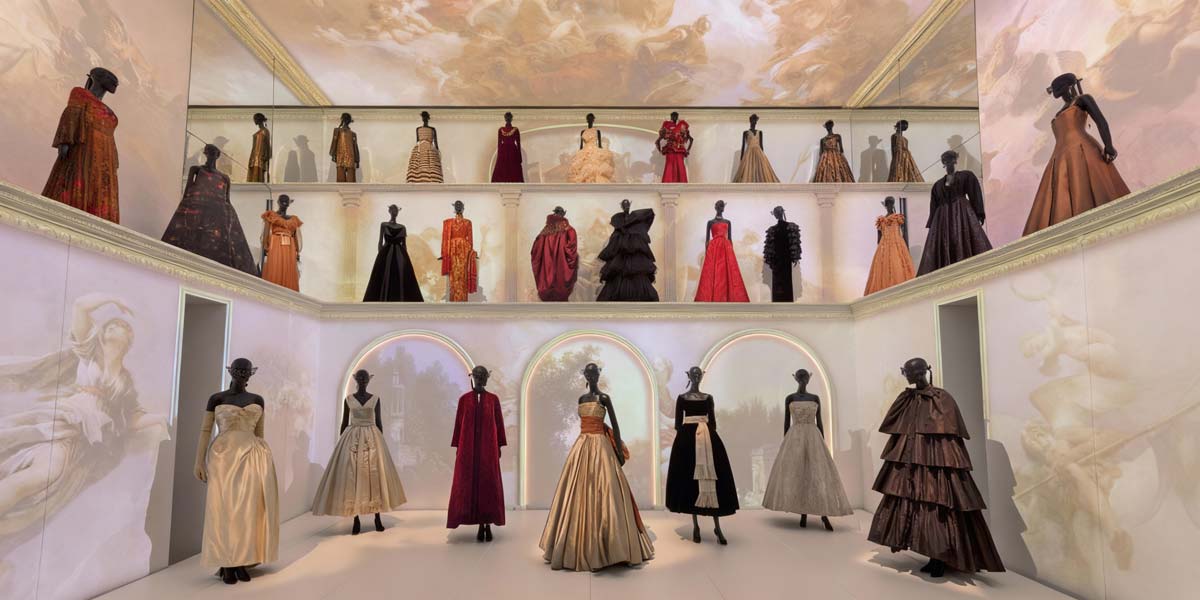
101 looks. That sounds like a round number, but it’s the result of decades of deliberate collecting. Alaïa’s collection includes early atelier work, iconic Bar jackets, evening gowns in silk and tulle, as well as experimental pieces from periods even fashion archivists know little about. Some of these objects exist nowhere else in the world outside this collection.
The presentation in Paris is deliberately kept intimate. No mass viewing, no rushing through. The looks are arranged so you can see the handwork – the stitches, the construction, the decisions that kept an atelier occupied for weeks. Anyone who has ever looked into runway and catwalk work understands immediately: these dresses weren’t made to stand still. They come alive in motion.
The Curatorial Decision Behind the Selection
Not all 101 pieces are spectacular in the conventional sense. Some were deliberately chosen to be understated – a tailored suit, a simple navy evening dress. The curators respected Alaïa’s own hierarchy: for him, the quality of the work mattered, not its exhibition value. That makes the show more honest than many retrospectives – and more demanding for the audience.
What Fashion Professionals Can Learn Here
Exhibitions like this are more than inspiration for aspiring models – they’re education. Anyone who understands how a dress is constructed wears it better. Anyone who knows the history of a silhouette interprets it more convincingly on the runway. The best models know what they’re wearing. That’s no accident, but part of the preparation – just like preparing for a casting or putting together your model portfolio for casting.
Anyone who’s serious about entering the industry should know places like this. Paris isn’t just a city – it’s a curriculum. Alongside the Alaïa-Dior exhibition, there are dozens of other institutions, galleries, and showrooms that convey a deep understanding of fashion. That knowledge is what separates mediocre applications from compelling ones.
Understanding Fashion as a Career Advantage
Agencies notice immediately whether someone merely consumes fashion or truly understands it. Anyone who wants to impress at a casting at CM Models doesn’t just bring measurements – they bring attitude, knowledge, context. That shows in how you move, how you talk about looks, how you react to styling decisions. Anyone who knows the model measurements and requirements has taken a first step. Anyone who additionally understands how couture is constructed is a decisive step further.
For anyone still at the very beginning: the steps to becoming a model often start with self-education – and an exhibition like this is part of it.
Comparison: Alaïa vs. Dior – Two Philosophies, One Exhibition
| Feature | Christian Dior | Azzedine Alaïa |
|---|---|---|
| Silhouette | Full, structured, opulent | Close-fitting, body-conscious |
| Materials | Tulle, silk, wool gazar | Jersey, leather, knitted layers |
| Philosophy | Femininity as a dream | Femininity as reality |
| Atelier Tradition | Large haute couture house | Small, tightly controlled studio |
| Relationship to the Fashion Industry | Central player | Deliberate outsider |
| Relationship to Time | Seasonal rhythm | Outside the calendar |
Experiencing Paris – And Taking It With You as a Model
Anyone traveling to Paris travels to the heart of the fashion world. The city carries a natural ease with fashion that you simply don’t find elsewhere. For aspiring models, a stay in Paris is its own kind of training. The same applies to other fashion capitals: anyone with the opportunity should also look into what it means to work as a model in London or as a model in New York.
Milan Fashion Week and London Fashion Week round out the picture of international fashion systems. Anyone who knows all these cities – even just as a visitor – understands why agency work functions so differently across markets. A model agency in Berlin works differently than a model agency in Hamburg or an agency in Paris.
Practical Tips for Visiting the Exhibition
- Book early – tickets are limited
- Audio guide available in English
- Photography allowed in parts
- Plan for at least 90 minutes
- Combine with the Musée des Arts Décoratifs
- Best time: weekday mornings
Your Checklist for the Visit
- ☐ Reserve your ticket online in advance
- ☐ Research Alaïa’s background
- ☐ Refresh your knowledge of Dior’s history
- ☐ Bring a notebook or note-taking app
- ☐ Comfortable shoes – a lot of standing time
- ☐ Plan to combine it with other Parisian museums
- ☐ Check the Paris Fashion Week dates
- ☐ Take photos for your own moodboard
Anyone using Paris to develop further is well advised to also work concretely on their own career. Whether it’s about the requirements for becoming a model, questions about minimum height at model agencies, or getting a foothold as a curvy model – information is the first step. The second is the Apply Now moment.
Frequently Asked Questions About the Exhibition and Starting Out in Fashion
Is the Exhibition Suitable for People Without Fashion Expertise?
Yes, absolutely. The exhibition explains its pieces through the presentation itself – the handwork, the materials, the construction are all visible. Anyone with no prior knowledge learns through observation. Anyone already engaged with fashion will dig much deeper. Supplementary reading on German fashion designers sharpens your understanding for international comparisons.
What Sets This Exhibition Apart from Other Fashion Exhibitions?
What’s unique is the origin of the collection: Alaïa collected these pieces privately – not as an institution, but as a connoisseur. Many of these looks exist nowhere else in this quality and completeness. Even the Dior archive no longer owns some of these pieces. That makes the show a historical document, not just an aesthetic experience.
Is Paris Worth It as a Destination for Aspiring Models?
Clearly, yes. Alongside New York, London, and Milan, Paris is one of the four most important fashion centers in the world. Fashion Week Berlin is a good start for the German-speaking market, but anyone who wants to work internationally can’t avoid Paris. Information on the top 10 model agencies shows which houses are strong in which cities – and how to recognize a reputable model agency.
How Do I Prepare for an International Casting?
Preparation means more than the right outfit. A complete model portfolio for casting is essential, as is knowing your own model measurements. Anyone who knows what agencies are looking for, and has worked through the basics of preparing for a casting, walks into any room far more confidently. Cultural knowledge – about exhibitions like this one, for instance – isn’t a bonus here, it’s part of the personality agencies are looking for.
What Fashion Professionals Take Away from Exhibitions Like This
Anyone who wants to seriously enter the fashion industry understands: education doesn’t start in the atelier. Exhibitions like the Alaïa-Dior show are living lessons in tailoring, material choice, and fashion thinking. Anyone who knows the history wears clothing with a different attitude – and agencies see that immediately.
- Visit at least two fashion exhibitions a year to sharpen your visual memory
- Study the differences between haute couture and prêt-à-porter directly on the pieces themselves
- Document your observations for the casting conversation – agencies appreciate context
- Connect historical fashion knowledge with current runway trends
- Consciously use museum visits as part of your professional preparation
“Anyone who only knows fashion from their feed has only understood half of it. The other half is hanging in display cases.” — Stylist, Paris Fashion Week 2024
The path into the industry runs through becoming a model and a well-founded application to a model agency. Anyone who additionally understands how fashion functions as a cultural asset brings a depth that stands out immediately at castings. And anyone who knows the requirements for modeling knows: personality and education matter just as much as measurements and looks.

Artur Ritter für Adidas Running x Courir - Model in Paris

Private Jet to Paris, Monaco and Milan: What Does It Really Cost?

Maison Margiela Haute Couture Spring-Summer 2024: Makeup & John Galliano

Louis Vuitton Men's Fall/Winter: Paris, Cowboys & Pharrell Williams
Louis Vuitton Sandwich Bag Hype: Da ist sie!

Modeln im Ausland: Internationale Arbeit einer Modelagentur







CM Model Casting Tour 2024: Dates - London | Berlin | Milan | Paris | Cologne | Barcelona | ...

Model Fitting für Chanel: Behind The Scenes für die Haute Couture Show

CM Scouting Spring / Summer '22: Casting Termine Mailand, Paris, London & Berlin

FIV Magazine Deutschland Podcast mit Ella / VR Model! Stream auf Spotify, Deezer, Google + Apple