Instagram Tips: Followers, Fans, Reach, and Marketing Strategy
Instagram tips – for young startups, fashion designers, and stylish restaurants, but also for established companies that are 50 or 100 years old, Instagram is uncharted territory for many when it comes to marketing! What does it mean to be successful on Instagram? How do you build a community? How do you gain more followers? When should you post, and how often? So many questions! That’s why we met up with an Instagram expert some of you may already have seen on Sat1, Pro7, or RTL: Stefan M. Czaja, one of the leading experts in the field, who’s not only a regular TV guest but also speaks in front of up to 300 people as a speaker on marketing and social media. If you want to learn even more about Instagram marketing, you’ll find many blog posts on his social media agency’s website: Instagram Tips.
Today he gives us a brief overview of social media marketing on Instagram. We also talk about bought likes – is it worth it? We also wanted to know: is there software he’d recommend as an expert for startups or young fashion designers? Basically as an affordable digital social media manager. Because especially at the start, as a startup, you have to watch every euro! So let’s get into our expert’s tips for your Instagram marketing & community management.
What Does Success on Instagram Mean? Community and Followers
Success on Instagram means an active community. Fashion trends, outfits, travel destinations – all those beautiful photos are worth nothing if no one’s interested in them. Community management, community building, and, very importantly, community care are the foundations of Instagram marketing for companies. This isn’t just about selling anymore, it’s about brand awareness. Brand awareness is a term used by advertising agencies and stands for how well-known or recognized a brand is. What matters most here is the connection, the relationship, between the brand and prospects and customers. Both of these groups need to be considered in how you communicate, and of course also when it comes to creating value for your own followers. That value can be simple questions to learn your followers’ honest opinions, or relatively simple actions like exclusive discounts available only on your Instagram channel. But value also means responding to comments. 85% of all startups and companies ignore comments from their own community. Yet someone took the time to engage with the brand. If they don’t get a response often enough, that fan will sooner or later stop engaging. The fewer comments there are, the less motivated other users are to comment on the content. The constant interaction between the channel – meaning you as the founder, the social media manager – and the audience is the central tool for success on Instagram.
Community Care
Even the first 100 fans matter when it comes to building your community. Because your first 100 followers are your first 100 brand advocates. They don’t need to be convinced anymore, they’re already on board. Just as important are your first 1,000 followers – a goal a lot of people will now naturally say, only 1,000 fans? Let me take you on a quick detour with a small example. Just ten years ago, before Instagram and the whole world of social media existed, a young fashion designer trying to promote their own collection had to hand out flyers, make phone calls to buyers, and try to get press placements in magazines – all nearly impossible for a young designer! Getting media coverage in fashion magazines in particular simply wasn’t possible without sufficient financial resources. Social media has changed that: with a single photo or video, you can reach up to 1,000 fans from your own circle. Without a single phone call, without handing out a single flyer, without an appointment with a buyer to possibly get included in the new collection. Using your own resources, almost for free, you can reach 1,000 people who already like you anyway. Marketing has never been this effective! That’s why the community is so important, and that’s why your first 100, as well as your first 1,000 fans, matter so much to you!
When I visit companies as a consultant, I very often hear that their own social media manager is unhappy because they only have 8,000 fans – of course 80,000 fans would be much better. But why not be satisfied? Anyone who was already happy at 100 fans, and happy at 1,000 fans too, reacts differently, likes their community more, interacts more, and projects a more positive image. You should always keep your ambitious goals, but you should also be happy with what you’ve achieved, and make that clear to your own community too, by staying present, interacting with people, and asking for their honest opinions.
Interaction and Software
For many startups, having a dedicated social media manager who spends three or four hours a day looking at other channels, tracking trends, giving likes and comments, is simply too expensive. Giving likes and comments on other channels every day yourself would obviously be too much effort alongside the important tasks around acquiring new customers, bookkeeping, and general management. That’s why many, but also many large companies, rely on social media software instead.
So the interaction on your own channel – with your own photos and videos, as well as direct messages – you handle yourself. All the interaction on other channels, meaning liking and commenting on other photos and videos, is handled by the software. Maybe later we can go into a practical example of just how much social media software helps with day-to-day work and how much time it saves!
Visual Language and Harmony
The second aspect is that, with increased motivation, the image content becomes more creative and varied. Often it’s just the details that make the difference, but over the long term those details have a big impact. So before you even think about a concept or a strategy, it’s about finding your own visual language. As a social media manager, I can only recommend looking for inspiration on other channels, especially if bringing creativity into photos isn’t something you do every day. And of course, you’ll find that inspiration right on Instagram!
Finding Inspiration on Other Instagram Channels
Many will say now, that’s obvious! But from my experience, I know that many companies, especially ones that haven’t done anything in social media marketing before, spend many days and weeks on concept development. In the end, an hour on Instagram might have been enough, looking at competitors’ offerings but also completely different accounts, for example just successful influencers.
- Which photos work?
- Which visual language works?
- Is it more about the portrait, or the whole body?
- Are there a lot of details in the image, or does the photo focus on one specific subject?
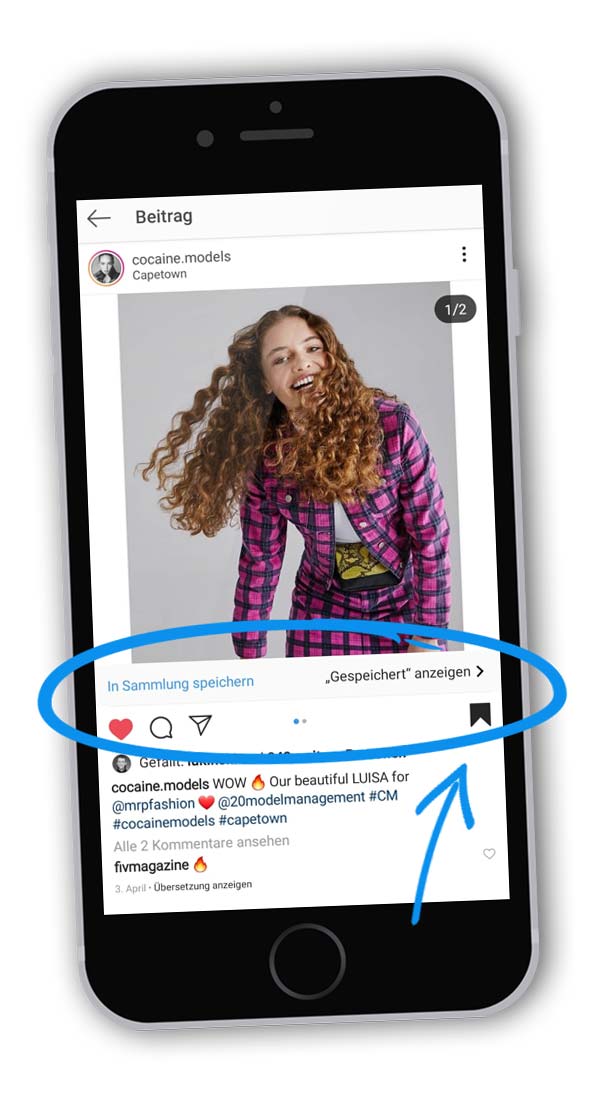
My ultimate Instagram tip, both for building the channel and for ongoing management: save photos within Instagram! A lot of people don’t use this feature, even though it’s really simple. You can save other people’s photos directly as inspiration inside Instagram, and you can even create different folders. That way you can separate them, for example, into photos of the team, photos of the product, lifestyle photos, photos of new arrivals, photos from trade fairs, …
To save a photo, you just have to tap the icon below the image. From there, the photo or video goes into your saved content. If you’re quick, you can then directly pick a folder to save the photo under. That way you always have these photos as a constant source of inspiration, both for yourself and for employees or freelancers. Another small everyday Instagram tip: with a big archive of inspiration, you also have good ideas available in moments when you’re feeling less creative. For example, anyone standing at a Fashion Week right before the first runway show usually has little time to come up with creative concepts for Instagram. With a glance at your saved photos, you’ll have plenty of ideas and might immediately find a way to adapt one for the current situation.
As I said, in practice many companies spend days and weeks thinking about what their images should look like. It goes much faster with a look at Instagram, and at bloggers and companies who are already doing it successfully. As a startup, this saves you a huge amount of time and, of course, money too. You can then focus your creativity back on your new fashion collection, or of course on other areas of building your company.
But the be-all and end-all for Instagram are beautiful photos and a harmonious style for the Instagram feed.
Beautiful Photos Matter on Instagram – Your Own Style
The ultimate tip: beautiful photos! Not everyone thinks about this – in a lot of real-world examples, we as consultants see photos with way too much text, ideally spread across ten lines, with five different subjects, for example for a giveaway. The next photo is dark, showing tons of products. The next photo is a selfie. No visual style, no consistency, no visual language. Yet recognizability is so important for companies. Just look at the basic practice: every company has its own color. Every company has its own typeface, every company has its own concept. People need this recognizability, not just so we as a company have an advantage – they also get used to a certain look and don’t want to miss it, because they like it. If we deviate from that look too often, the bond weakens, and the follower may eventually drop off.
For Instagram, you always have to be clear on one thing: you need a visual language, and you can’t be too in-depth or pack in too much information. Why is that? On Instagram, both in the feed and in Stories, you only have a few moments of someone’s attention. The next photo, the next video, is just one swipe away. So information has to be clear, precise, and very to the point. When you’re taking your photos, make sure that
- You have a consistent style, consistent color palette
- Images focus on one subject, avoid too many details
- Don’t use text or captions inside the image
- Bright, friendly photos are successful, dark, emotionless photos are not
- Sexy always works!
Filters? Colorful Isn’t Everything
Since we were just talking about bright, friendly photos and their success on Instagram, here’s the next Instagram tip right away! Don’t use filters. Filters make photos look different – creative, colorful, vintage, but also just too much. Instagram is usually about authentic everyday life, not advertising. Photos don’t need heavy post-processing, they need creative ideas. I skip filters entirely, right from the start.
A small tip: adjustments are fine. My recommendation:
- Brightness + 8 %
- Warmth + 8 %
- Saturation – 8 % for cooler, slightly desaturated images and + 8% for more colorful images
This slight image correction makes a photo a bit brighter, a bit friendlier and more appealing, but it’s not comparable at all to heavy post-processing or filters. This is just about a small adjustment of the values.
Camera or Smartphone? The Right Equipment for Instagram
One of the absolute favorite questions from companies and businesses, but also from startups and young entrepreneurs: do you need a professional camera for Instagram?
Anyone with a modern smartphone from the last few months knows how far camera technology has come. From time-lapse recordings for videos to photos with different depth-of-field effects, you can conjure up practically any photo and any video on a smartphone these days. Camera technology has become so sophisticated and compact that extremely good cameras are hidden inside smartphones today. For social media management, you honestly don’t need a DSLR camera anymore, a good smartphone is absolutely enough. That way you’re killing two birds with one stone: you always have all your social media networks with you, and a good camera too. That lets you not only pre-produce social media content for Instagram, but even go live, for example on Instagram TV. Moments get captured much faster, since there’s less gear to set up. On top of that, you save yourself from having to carry around a big, heavy camera and its batteries. In comparison, for me, the smartphone clearly wins!
Portrait or Square? The Right Format for Photos
Surface area is everything! Whether it’s a billboard downtown or a photo in the Instagram feed. When you’re taking photos, make sure you hold your phone in portrait mode, not landscape. That gives you a lot more surface area on Instagram. If you post a photo or video in landscape format, for example, you only get about a third of the space you could have in portrait format. So here’s a small but practical Instagram tip: make sure all your photos and videos are shot in portrait mode!
More Followers? Here’s How to Build Your Instagram Community
Now we get to the million-dollar question! How do I get more followers? How do I get them very fast? How do I get them guaranteed? There’s never a guarantee!
The community is made up of individual people. Every person has their own thoughts, ideas, needs, and wishes. Social media campaigns can never be planned with a guaranteed outcome. Just think about virality, the topic everyone talks about. Can we make a viral video too? If social media management were that simple, probably every channel would have a billion fans, every video would have a billion views. But that’s just not how it is. Competitors are always part of the mix too – there are the long-established companies, new creative players, and on top of that the countless bloggers publishing content completely for free, every single day. They also have the extra advantage of being private individuals rather than companies “that just want to make money.”
My tips for Instagram:
- Building a community, as discussed above
- Genuine community care and communication with followers
- Creative content with a consistent visual language
- Regular posting, ideally daily
- Increasing reach through paid posts
There are two ways to generate reach. Organic reach and paid reach. Organic reach is the reach you get through the algorithm within your own community.
- The algorithm is influenced by various parameters, e.g. the posting time – when is something published, and how much competing content is there at that moment?
- How much initial interaction happens within the first few seconds? How does engagement develop over the following minutes?
So organic reach describes the people you reach purely through the impact of the post itself. On top of that, there’s paid reach, meaning ads. Because with organic reach you typically only reach ten to 15% of your own followers. So if you have 10,000 followers, you usually reach 1,000 to 1,500 people. Paid reach lets you increase that number of people. Paid reach is then based on views, meaning the number of times a post was seen. Paid reach is valuable because organic growth alone wouldn’t reach nearly as many people. Which is a shame, because if, on average, one in every 200 people who interact with a post ends up ordering a product, it would be very useful to reach even more people. That’s why companies run ads.
But fundamentally, it always comes back to organic growth and organic engagement, because it’s not just growth that matters, but also your regular, loyal audience! Through good copy and getting fans involved, for example through challenges, your own community stays active.

Smart Captions and Instagram Challenges
Smart, clever captions are definitely short! Nobody on Instagram wants to read something long, it’s about photos, videos, quick and short entertainment. That’s why captions should always be short and should give users a prompt. Prompts like a call-to-action, references to our actual offer, but also prompts like questions that ask users to share their real experiences. Questions are a very effective tool, ranging from a simple “would you wear it?” all the way to “what color was your dress at prom?”
But smart captions aren’t just descriptive or full of questions, you should also always think about mentioning other brands or people, or tagging them directly on Instagram. That gives you a positive image transfer. If a photo shows, say, a Fanta, which is often drunk by younger audiences, it’s worth mentioning Fanta in the caption too. Image transfer. The same naturally goes for social media stars: if someone is wearing a certain piece of clothing, that person should also be mentioned and tagged. That not only makes sure the person finds out about the new post and can immediately react with a like or comment, which in turn boosts early interaction, which in turn pushes your own post up in the algorithm. It also means the post gets made accessible to parts of that other person’s audience too. On one hand, in the feed, since that’s where you see mentions and tags where the respective account was tagged; on the other hand, part of it also gets pushed out to their audience, insofar as parts of that audience interact with the photo or video.
Number three is call to action. For anyone who hasn’t heard the term before, here’s a quick explanation.
Call-to-Action in Posts and Stories
Call to action is one of the central tools in online marketing. Call to action means a direct pointer to whatever our specific goal is, which could for example be a product in the online shop, signing up for the newsletter, or new fans for our channel. Depending on the goal, we actively point to what we want to achieve in our captions. For example:
- Get 10% off in the online shop now, click here
- Sign up for the newsletter now, tomorrow the new feature drops!
- Follow us on Instagram now!
All of these are active prompts to take action, calls-to-action. To complete the process, you still need a link. Unfortunately, you can’t place a link directly in an Instagram post, but here you can point out that the link is in your bio. That way users aren’t just asked to click the link, but also to visit your Instagram channel. In Stories it’s different: there you can place direct links, and followers can visit the link with a simple swipe up. Whether it’s the online shop or a newsletter sign-up, a direct call to action.
- Swipe up for 10% off
Using Instagram Stories
Referral marketing is a big topic. Influencers in particular show just how effective it can be to drive sales through reviewing or describing products. The more personal and authentic the glimpse into someone’s life, the more purchase intent tends to rise. Instagram Stories are an excellent tool for giving people that personal glimpse. Of course, the bigger the company you’ve planned, the bigger the Stories get too. But the big advantage is that they disappear after 24 hours, and you can post several a day. Instagram Stories are produced very quickly, and most people have probably already made a few themselves, or even make some every day. The big advantage: they follow a much less strict structure than, say, posts in the Instagram feed. There, the feed ultimately has to look harmonious, the visual language has to be consistent, … with Instagram Stories, all of that is much easier! You don’t even have to be that creative here – a super simple example would be the breakfast table with a nice spread. After that it’s off to the office, coffee, and a look at a few collection pieces. Later there’s a client meeting, and a quick photo gets taken of the takeaway cappuccino, then in a short video you mention that you’re now heading to a great client you’re really looking forward to seeing. Small, intimate stories that stay with the user throughout the day.
Brand awareness is a big topic, meaning how well-known or how present a brand is in people’s minds. Instagram Stories are an excellent tool for constantly sending out little messages.
So when do hashtags actually make sense? A really good question. We could go into great detail here and philosophize about it for a long time, but ultimately it’s about using hashtags as precisely as possible. Instagram tip 1 on hashtags: don’t use hashtags meant purely for follower growth. Those always suggest “follow me and I’ll follow you” or “like my picture and I’ll like yours.” Why doesn’t that help? This whole time we’ve been talking about community and interaction, about fans who react to new photos and new videos, not ghost accounts that interact once and then never do anything again. These tags motivate other new accounts, or even social bots, to interact with your channel. Real fans aren’t part of that. Tip number 2 for hashtags: focus on very precise terms.
Instead of 20 hashtags, we focus on our core product and our image. Both get 3 precise, fitting hashtags
- Three general hashtags like #Beauty, #Eyeliner, #Makeup
- 3 specific hashtags for the image, #Contour, #Makeuplover, #Eyeshadows
The goal is to reach the top positions. Ideally, of course, always rank 1, just like with Google!
Heat Map Positioning in Online Marketing
We all know the search engine Google, the most important platform when it comes to answering questions on the internet. Where do I find something? What does something mean? What does something stand for? Where do I find more information about something? The golden rule in online marketing is position one. The closer you are to that position, the more often you get clicked, whether on Google or on Instagram. Looking at the world’s biggest search engine, you can see very clearly where users’ attention actually focuses: green means often, yellow very often, and red almost exclusively.
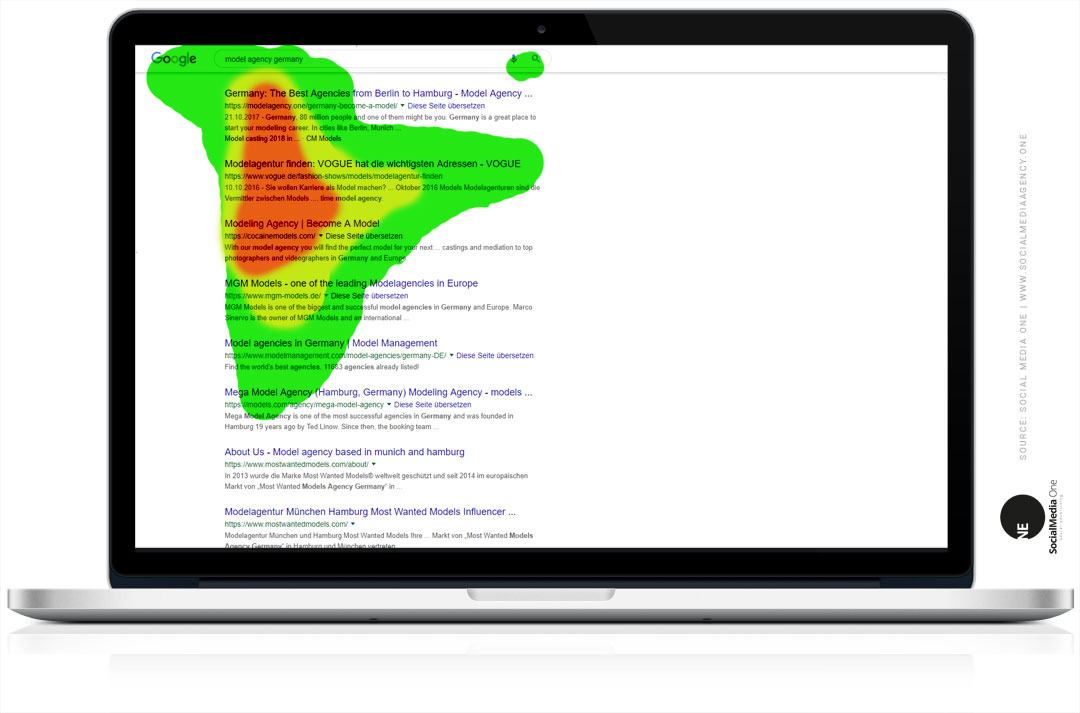
Buying Followers? Followers for Your Channel
There are actually a lot of people who buy followers. We’ve had bloggers reach out to us, and on closer analysis, out of 250,000 followers, at most 20,000 were real people. Even big companies use these methods, buying up 10,000, 100,000 fans over the years. You can spot this quite easily, even without social media software, just by looking at the comments. If someone has 200,000 followers but only two comments, something’s off.
Buying followers is pretty easy, you’ll find plenty of offers online. 10,000 fans for $20, international, from India to the Philippines, all the way up to “quality” 10,000 fans for $300 from German-speaking countries. In the end, though, those are probably not real people either, just social media bots.
These accounts will never actually engage. On the other hand, just to explain, a lot of visitors don’t analyze Instagram channels at all. They just glance quickly: 100,000 fans, lots of people like this, I’m in. So there are two sides to the coin. What’s best for you personally is something you have to weigh up yourself.
Thank you so much for the in-depth conversation. Valuable tips for all our readers who want to go into business for themselves, with their own startup, in fashion design, or in the food industry. Thanks for your time!
Questions and Answers
What Kind of Platform Is Instagram?
As a social network, Instagram is a platform where users can interact with each other. Currently, the most popular formats are photos in the feed and Instagram Stories. The feed is usually used daily, or two or three times a week. Stories can be made several times a day, and they’re only available for 24 hours. Other users react to these posts and stories. That can even lead to small conversations, for example in the comments. The more interaction, the better! Many users also send direct messages, which are private messages from one user to another.
On Instagram, you can decide for yourself whether to keep your account private, so that only approved users have access to your photos and videos, or whether the account is publicly accessible. The default setting, of course, is public. For users, Instagram is especially about briefly distracting themselves during everyday life. At the breakfast table, while waiting for the subway, during short breaks at work, and of course in the evening too, for example while waiting for a date or for friends.
Users typically open the Instagram app six to eight times a day. That reflects a very high level of interaction. Small, short pieces of content, so-called snack content, work best with Instagram users. Photos, Stories around 10 to 15 seconds long, or videos of about 10 to 15 seconds too.
Is Instagram a Trademark?
Yes, Instagram is a registered trademark and therefore protected in almost every country in the world. You can find more on Instagram, business figures, revenue figures, and much more on Wikipedia: Instagram.
Who Owns Instagram?
Instagram isn’t actually all that old. After just a few years, the network was bought from its two founders. Facebook has been the new owner ever since. That means Instagram officially belongs to Facebook Inc.
Did you know? Ads are also organized through the Facebook Ads Manager. Although Instagram also allows you to boost posts directly within the app, the Facebook Ads Manager is much more precise.
How Many Employees Does Instagram Have?
In 2010, Instagram started with just 13 employees; today there are thousands worldwide. Instagram has developed significantly, especially since being acquired by Facebook – from ads all the way to IGTV.
Is Instagram the Same as Facebook?
Instagram and Facebook differ in many ways, but they’re also similar in others. The biggest difference lies in the target audience: Instagram’s audience is significantly younger compared to Facebook’s. Facebook now serves almost every age group, with most registered users being between 20 and 50 years old. On Instagram, the audience is, as described, noticeably younger, usually between 15 and 30 years old. Another big difference lies in how the media is used. On Facebook, all kinds of content get shared, articles from other websites, as well as events and news. On Instagram, everything focuses on news, image and video content, and small posts from everyday private life, so-called Stories.
Instagram is also more fast-paced and is accessed largely from mobile devices via the app. Facebook, on the other hand, is also used by many as a communication tool from a desktop PC or laptop. This again reflects the differences between the audiences. Depending on the product or service and the target audience using it, you should, especially at the start, focus on one social network. That saves a lot of time and lets you manage one network effectively.
What Can You Do on Instagram?
On Instagram, almost everything centers around posting new photos and videos. This happens in two forms. Either you post photos and videos to the Instagram feed, which is Instagram’s timeline where all posts are archived chronologically. On the other hand, Instagram Stories are used a lot too. Instagram Stories are very private and show personal life, from morning to evening. Every channel has its own quirks: bloggers and influencers share every moment of life, from waking up in bed, to breakfast, to going to sleep; companies show a lot too, including many things they wouldn’t have shown in the past. Why? Because they can!
In the past, it was extremely hard to get into the media. Especially for young fashion designers or fashion companies, it was very difficult to get placements in a fashion magazine. We don’t even need to talk about TV advertising or placements in other magazines. Today, thanks to Instagram but also social networks like Facebook, YouTube, and TikTok, anyone can constantly post something new. Wonderful new world!
What Is Instagram Marketing?
Instagram marketing deals with all the specific characteristics and quirks that the social network Instagram brings with it. As an Instagram agency, you develop concepts and strategies so that companies, for example, know exactly how to proceed on Instagram step by step. This is especially important when the work is split among several team members, where having structure and planning matters.
Anyone planning their own Instagram marketing should create the same kind of structure and planning. Where do I start? Where do I want to end up? All of that needs to be held together by a clear thread running through everything. You follow that concept, that strategy, day after day. From the experience and learnings you gather every day, you can optimize your own Instagram marketing bit by bit. The big goal in Instagram marketing is reach. The more reach a startup gets, the more information it can put out. That’s why the community is a central part of Instagram marketing. Another central part for many companies and online shops is advertising on Instagram. Because, how do you actually make money on Instagram? Of course, just like everywhere else, through selling products and services. Ads help you reach additional people on top of organic traffic, meaning the reach you can generate without ads.
What Is Reach on Instagram?
Reach on Instagram corresponds to the number of followers who have seen a post. Within reach, there are, in turn, two different factors.
Simple reach, the so-called views, correspond to the number of times our post was displayed. A single person can easily be shown our post multiple times. Every new display generates a new view. In contrast, there’s unique reach, so-called unique views. Here, only individual people are counted. Whether a single person gets shown the post multiple times doesn’t matter at all in that count.
Both factors matter in advertising. If you remember classic TV commercials, you know that the more often you see an ad, the more likely you are to remember the brand and buy the product in the online shop or supermarket. It’s the same with reach: the more often a person sees the brand or the product, the more likely they are to choose exactly that one when buying. When looking at pure reach, for example during a product launch, it’s more about unique views, so the ad agency can calculate how many people were actually reached.
What Are Instagram Ads?
Instagram Ads are advertisements shown within the social network. Ads look just like completely normal posts or Stories; they just carry a small “Sponsored” label. Instagram Ads are very effective, just like ads on other social networks. Especially because target audiences can be defined so precisely, geographically, for example everyone in Berlin, just as much by gender, e.g. only women in Berlin, but things like age and interests factor in too. So a specific coat or an expensive leather jacket can be shown only to a specific group of people who, on one hand, can most likely afford that expensive leather jacket, and on the other hand already have similar interests, e.g. similar brands and products.
How Much Does Advertising on Instagram Cost?
There’s no fixed price for advertising on Instagram. Depending on how much competing demand there currently is for ad space, how many people are online at that time, a lot of factors come into play. As a rough rule of thumb, though, you can say that prices per view can range between 5 cents and 5 euros, depending on how good the ad itself is. That’s why a lot of companies trust us as a social media agency for campaign management. Self-set-up ad campaigns on Instagram tend to land more in the range of 4 to 15 euros. And if it takes 100 views before a single purchase happens, costs explode quickly. But anyone who manages, together with a social media agency, to push prices down below 1 euro, can quickly achieve solid profits and make money on Instagram.
How Can You Make Money with Instagram?
There are two ways to make money on Instagram. One way is the classic sale of products. As described above, that means building your own community, within which you can then showcase new products.
Alongside that, a completely new line of business emerged within social networks: influencer marketing! Young, hardworking bloggers who gradually gained more and more fans today reach millions of people and are the new stars, the social stars! As an influencer, you can make really good money; anyone who wants to know roughly how much you can earn on Instagram can, for example, calculate the fees and rates using an influencer fee calculator. Influencers earn their money either through paid posts, meaning posts that are directly paid for, or through affiliate marketing. Affiliate marketing is a classic from online marketing. You earn a sales commission. If an influencer, for example, posts a new expensive leather jacket, the link gets clicked by 100 people, 40 people buy the jacket, and the influencer gets a 10 euro commission per jacket, that’s 400 euros for that one post.

Medienagentur: Foto, Video, Modenschau + Social Media

Strategie Agentur: Marken Führung und Positionierung - Aufgaben
Influencer Marketing Agentur: Kampagne, Strategie, Ziele - Aufgaben

1000 Follower auf YouTube: Danke ihr Lieben! + Making Of Special

Runway Debut: Ariane and Luisa for Vogue x Breuninger

Snipes x Adidas with Ariane in Berlin - New Streetwear